
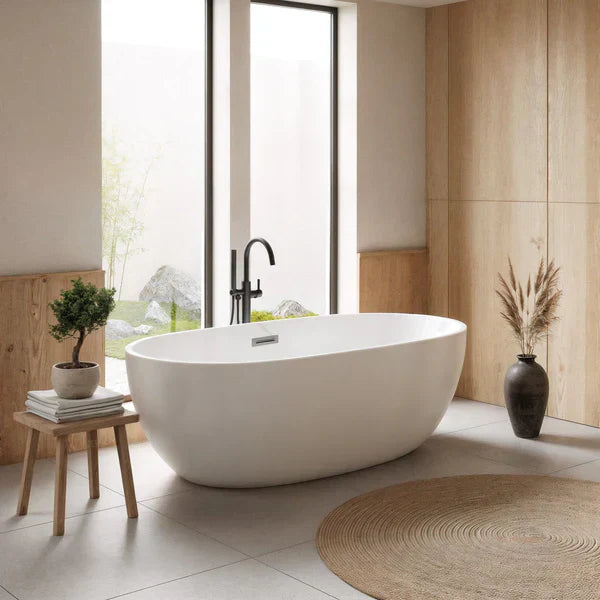
Renovating an Australian bathroom is a high-stakes balancing act. You are juggling aesthetic dreams against the rigid reality of plumbing lines, waterproofing regulations, and the physical square meterage of your home. At the heart of this puzzle sits the bathtub, often the largest fixture in the room and the ultimate symbol of relaxation.
Getting your bathtub dimensions right isn't just about whether the tub looks good in the showroom; it’s about ensuring you don't have to shimmy sideways past the vanity or realise, too late, that your water heater can't actually fill the "statement" tub you just installed. This guide will walk you through the nuances of Australian sizing, from the metric benchmarks to the compliance hurdles you need to clear.
The Importance of Getting Your Bathtub Dimensions Right
In a bathroom, every millimetre counts. Unlike a living room where you can push a sofa ten centimetres to the left, bathroom fixtures are "locked in" by waterproofing membranes and drainage points. If you choose a tub that is even slightly too long, you risk encroaching on the required clearance for your toilet or doorway, which can lead to a failed building inspection.
Beyond the logistical headache, there is the human element. A tub that is too short for a tall homeowner turns a relaxing soak into a cramped ordeal. Conversely, a tub that is excessively deep might be a nightmare for a young family trying to bathe a toddler without straining their backs. Precision at the planning stage ensures the bathroom feels harmonious and functions effortlessly for everyone in the household.
What is the Standard Bathtub Size in Australia?
In Australia, we think and build in millimetres. While there is no "law" dictating how big a tub must be, the industry has gravitated toward specific increments that align with standard Australian bathroom footprints. When you walk into a local supplier, you will find that most tubs revolve around a few predictable numbers designed to fit between standard wall studs or alongside common vanity depths.
The Common Dimensions: 1500mm vs. 1700mm
If you are looking for the "Goldilocks" of Australian bathtubs, you are looking at the 1500 mm and 1700 mm lengths.
The 1500mm tub is the workhorse of the Australian apartment and the secondary bathroom. It is compact enough to fit into smaller floor plans but provides enough internal space for children or a modest adult soak. If you are retrofitting a bathroom in an older brick veneer home, this is often the size you’ll be replacing.
The 1700mm tub is considered the standard for modern primary bathrooms (ensuites or main family bathrooms). It offers that extra bit of legroom that allows most adults to fully submerge. If your space allows for it, 1700mm is the sweet spot for resale value, as it caters to the widest range of body types.
Standard Width and Depth Benchmarks
While length gets all the attention, width and depth dictate the actual comfort of the soak. The standard Australian width is 750mm. This allows for a comfortable shoulder width without making the tub so wide that it consumes the entire floor. You will occasionally see "slimline" models at 700mm for tight renovations or "grand" models at 800 mm to 900 mm for those desiring a large bath in luxury master suites.
Depth, measured from the floor of the tub to the overflow or rim, usually sits between 400 mm and 500 mm. A 400mm depth is standard for a multi-purpose bath where you might also be showering (the "shower-over-bath" setup), as the lower side makes it easier to step in and out of daily.
Understanding Bathtub Capacity and Volume
Before you fall in love with a giant stone tub, you must consider the "hidden" dimension: volume. A standard 1500mm inset tub usually holds between 120 and 150 litres of water. However, high-sided freestanding tubs can easily swallow 250 to 300 litres.
This matters for two reasons. First, your hot water system. If you have a small instantaneous gas heater or an old 125-litre electric tank, a high-volume tub will run the water cold before it’s even half full. Second, water costs. Filling a massive tub every night can significantly impact your utility bills. Always check the "litres to overflow" specification before purchasing to ensure your infrastructure can support your lifestyle.
Common Types of Bathtubs and Their Dimensions
The style of bath you choose heavily influences how much physical and visual space it occupies.
1. Inset (Built-In) Baths
The inset bath, often referred to as a drop-in bathtub, is the traditional Australian choice. It sits inside a tiled "hob" or frame. Because it is built into the wall, it is the most space-efficient option.
- Common Lengths: 1500 mm, 1675 mm, 1700 mm.
- The Pro Tip: Remember that the "finished" size includes the tiled lip. If the tub is 1500mm, your actual footprint will be slightly larger once you account for the timber framing and tiles.
2. Freestanding Baths
The freestanding bathtub is the darling of modern Australian design. They sit directly on the floor and act as a sculptural centrepiece.
- Common Lengths: 1500 mm to 1800 mm.
- Spatial Note: Freestanding tubs require "breathing room." You generally need at least 100 mm to 150 mm of space between the tub and the wall to allow for cleaning and to prevent the room from feeling cluttered.
3. Back-to-Wall Baths
A hybrid of the first two, these look like freestanding baths but have one flat side that sits flush against the wall.
- Common Lengths: 1500 mm and 1700 mm.
- The Advantage: These are perfect for those who love the freestanding look but have a narrower bathroom where they can't afford the gap behind the tub for cleaning.
4. Corner Baths
Once a staple of 1990s luxury, the corner bathtub is now more niche but still useful for awkward layouts.
- Common Dimensions: Usually 1300 mm x 1300 mm or 1500 mm x 1500 mm.
- The Reality: While they seem space-saving, they actually have a very large footprint and use a significant amount of water.
5. Small Space and "Soaker" Tubs
For tiny terrace houses in Sydney or Melbourne, a compact soaking tub is gaining popularity.
- Common Lengths: 1100 mm to 1300 mm.
- The Design: These tubs are much deeper than average, allowing an adult to sit upright and be submerged to the shoulders despite the short length.
How to Measure Your Bathroom for a New Tub
Measuring for a tub is more complex than just checking the distance between two walls. You are measuring for three-dimensional clearance.
Accounting for Clearances and Walkways
The National Construction Code (NCC) and local Australian standards don't just care about the tub; they care about the space around it. You should aim for at least 600mm of "clear" floor space in front of the tub to allow for safe entry and exit. If the tub is next to a toilet, ensure there is at least 200mm between the edge of the tub and the toilet pan to meet standard comfort and cleaning requirements.
The "Wet Area" Compliance: Australian Standards (AS 3740)
In Australia, the installation of a bathtub is strictly governed by AS 3740 (Waterproofing of domestic wet areas). When you measure, you must account for the fact that the walls surrounding the tub must be waterproofed to a certain height. If you are installing an inset bath, the "lip" of the bath must be integrated into the wall tiling to ensure water runs back into the tub rather than behind the wall. This can add 10- 20 mm to your depth calculations once the cement sheet and tiles are applied.
Considering the Tapware Placement
Where will the water come from? A wall-mounted mixer requires the tub to be flush against the wall. A floor-mounted "gooseneck" filler for a freestanding tub requires an extra 150 mm to 200 mm of floor space at the end or side of the bath. Don't buy the tub until you know where the pipes are coming out of the ground or wall.
Choosing the Right Size for Your Household
Bathtubs for Families with Young Children
If you are bathing kids, depth is your enemy. A very deep freestanding tub makes it incredibly difficult to lean over and wash a child without straining your back. A standard 1500mm inset bath with a wide tiled ledge is usually the most practical choice; the ledge gives you a place to sit or rest your arms while you work.
Sizing for Taller Individuals: The Length Factor
If you are over 180 cm (6 ft), a 1500mm tub will feel like a bucket. You will likely want a 1700mm or even an 1800mm tub. However, be careful: if the tub is too long, you might find yourself sliding down into the water with no way to brace your feet. Many premium tubs now feature an ergonomic "lumbar" slope to help smaller people stay upright in larger vessels.
Designing for Aging-in-Place and Accessibility
As we age, stepping over a 500mm high tub wall becomes a trip hazard. If you are designing for the long term, consider a lower-profile tub (around 400mm) or ensure there is enough reinforced wall space to install grab rails later.
Critical Factors That Affect Your Choice Beyond Length
Floor Loading and Weight Restrictions
A standard acrylic tub is light, but a 1700mm solid stone or cast iron tub can weigh 150kg empty. Once you add 250 litres of water (250kg) and an 80kg adult, you are placing nearly half a ton of weight on a very small area of your floor. If you are renovating a second-story bathroom with timber joists, you must consult a structural engineer or builder to ensure the floor support can handle the load.
The Impact of Tub Material (Acrylic vs. Stone vs. Steel)
- Acrylic: The Australian standard, often reinforced with fibreglass. Lightweight, affordable, and holds heat well.
- Enamelled Steel: Often finished in porcelain, these are extremely durable and scratch-resistant, but feel cold to the touch until the water warms them up.
- Stone/Concrete: These solid surface options are stunning and retain heat for a long time, but they are incredibly heavy and require specialised installation.
For a more detailed comparison of the advantages, maintenance requirements, and long-term performance of different bathtub materials, see this guide on bathtub materials.
Plumbing and Waste Alignment
In Australia, the "waste" (the drain hole) is usually at one end or in the centre. If you are replacing an old tub, try to find a new one where the waste aligns with your existing plumbing. Moving a drain pipe in a concrete slab can cost thousands of dollars; choosing a tub that matches your existing layout can save you a fortune.
Common Pitfalls to Avoid During the Selection Process
The most common mistake is "The Showroom Trap." You see a beautiful 1800mm freestanding tub in a massive, open-plan showroom and think it will look great in your 2x3 meter bathroom. In reality, it will swallow the bathroom layout and make it feel cramped.
Another pitfall is ignoring the "internal" dimensions. Two tubs might both be 1700mm long on the outside, but one might have much thicker walls or a more aggressive slope, leaving significantly less room for your body. Always sit in the tub (yes, in the showroom!) before you buy it.
Summary Checklist for Your Bathtub Purchase
Before you tap your card at the checkout, run through this final checklist to ensure your Australian bathroom renovation goes off without a hitch:
- Measurements: Have you confirmed the exact wall-to-wall distance, accounting for the thickness of tiles and waterproof membrane?
- Clearance: Is there at least 600mm of space in front of the tub for safe access?
- Plumbing: Does the waste outlet on the tub align with your existing floor drainage?
- Hot Water: Can your hot water system fill this tub's capacity (in litres) without running cold?
- Weight: If choosing stone or steel, has a builder confirmed your floor can support the weight of the tub when full?
- Access: Can the tub actually fit through your front door and into the bathroom? (A common issue with large freestanding models!)
- Compliance: Does the tub meet Australian Standards, and have you planned for the necessary waterproofing (AS 3740)?
By keeping these standard bath sizes and Australian-specific dimensions in mind, you can transition from the planning phase to the first soak with total confidence. A bathtub is more than just a fixture; it’s an investment in your home’s value and your personal well-being. Measure twice, soak once.
Ready to find the right bathtub size for your bathroom renovation? Explore premium bathroom products or speak with the team at Luxern Home for expert support, quality fixtures, and stylish solutions designed for Australian homes.
Share: