
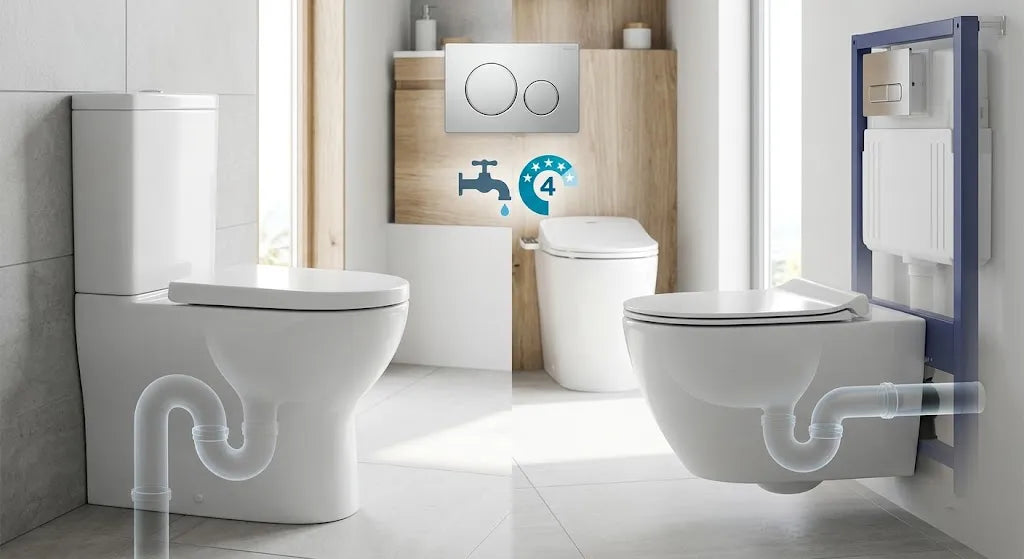
Choosing between different toilet types involves more than deciding which design looks best in your bathroom. The right toilet also needs to suit your existing plumbing, available floor space, comfort preferences and water-efficiency requirements.
Australian bathrooms can use several styles, including close-coupled, back-to-wall and wall-hung toilets. You will also need to consider the toilet's trap connection, bowl shape, height and flushing system before making a final choice.
This guide explains the main types of toilets and the differences that matter when choosing a new toilet for your bathroom.
What Are the Main Types of Toilets?
Most toilets can be grouped according to how the pan and cistern are arranged.
The most common toilet styles include close-coupled, back-to-wall, wall-hung, concealed-cistern and smart toilets. Each design differs in appearance, cleaning requirements, installation complexity and suitability for different bathroom layouts.
|
Toilet Type |
Main Features |
Best Suited For |
|
Close-coupled toilet |
Visible cistern connected directly to the toilet pan |
Standard bathrooms and straightforward replacements |
|
Back-to-wall toilet |
Pan sits close to the wall with fewer exposed gaps |
Modern bathrooms and easier cleaning |
|
Wall-hung toilet |
Toilet pan is mounted above the floor with a concealed cistern |
Contemporary renovations and compact spaces |
|
Concealed-cistern toilet |
Cistern is hidden inside a wall or cabinet |
Minimalist bathroom designs |
|
Smart toilet |
May include bidet washing, heated seats and automatic functions |
Bathrooms where added comfort and technology are priorities |
If you are replacing an existing toilet, it is also important to check the plumbing configuration before choosing a new model. Luxern Home's guide to P-trap and S-trap toilets explains this distinction in more detail.
Close-Coupled Toilets
A close-coupled toilet has a separate cistern positioned directly above and connected to the toilet pan.
It is one of the most familiar types of toilets used in Australian homes because the design is straightforward and works with many bathroom layouts.
Close-coupled toilets are generally easy to access for maintenance and are available in a wide range of sizes. Because the cistern remains visible, they can have a slightly more traditional appearance than concealed or wall-hung designs.
Some modern close-coupled models use a back-to-wall pan, giving the toilet a cleaner profile while retaining an accessible cistern.
You can compare different configurations in Luxern Home's toilet collection.
Back-to-Wall Toilets
A back-to-wall toilet has a pan that sits flush or almost flush against the wall, reducing visible gaps around the toilet.
Depending on the design, the cistern may sit directly above the pan or be concealed behind the wall.
The enclosed shape can make cleaning around the toilet easier because there are fewer exposed pipes and awkward spaces behind the pan.
Back-to-wall toilets work particularly well in contemporary bathrooms where clean lines and straightforward maintenance are priorities.
If space is limited, check your bathroom measurements before ordering. Luxern Home's guide to standard bathroom dimensions provides useful planning information for common bathroom fixtures and clearances.
Wall-Hung Toilets
A wall-hung toilet is fixed to a supporting frame inside the wall, leaving the toilet pan suspended above the floor.
The cistern is normally concealed behind the wall, with only the flush plate visible.
One of the main advantages of a wall-hung toilet is easier floor cleaning. Because the pan does not reach the floor, tiles can be cleaned underneath without working around a toilet base.
Wall-hung toilets can also make a smaller bathroom appear more open because more of the floor remains visible.
However, installation is more involved than with a standard floor-mounted toilet. The wall needs to accommodate the concealed cistern and support frame, so this type is generally easier to incorporate during a new build or major bathroom renovation.
Concealed-Cistern Toilets
A concealed-cistern toilet hides the cistern inside a wall cavity, cabinet or purpose-built enclosure.
The toilet pan itself may be floor-mounted or wall-hung.
The main benefit is visual simplicity. With the cistern hidden, the bathroom has fewer visible components and a more streamlined appearance.
Before choosing this style, consider how the cistern can be accessed if valves or flushing components need maintenance later.
S-Trap, P-Trap and Skew-Trap Toilets
The toilet style is only one part of your decision. The waste outlet must also match your bathroom's plumbing.
Australian toilets commonly use S-trap, P-trap or skew-trap configurations.
|
Trap Type |
Waste Outlet Direction |
Common Application |
|
S-trap |
Waste exits through the floor |
Common in many Australian homes |
|
P-trap |
Waste exits horizontally through the wall |
Often used with back-to-wall or wall-hung toilets |
|
Skew trap |
Waste exits to the side |
Used where the plumbing outlet is offset |
An S-trap toilet connects to a waste outlet through the floor, while a P-trap sends waste through the wall behind the toilet. CHOICE notes that S-trap connections are commonly found in Australian homes through its toilet buying guide.
A skew trap is less common but can be useful where the existing waste pipe does not align directly with the floor or rear wall.
When replacing an existing toilet, identify the current outlet before ordering a new one. Changing the waste location can require considerably more plumbing work.
Toilet Bowl Shapes
Another difference between toilet types is the shape and size of the toilet bowl.
Compact or round toilet pans take up less space from front to back, making them useful in powder rooms or bathrooms where door and vanity clearance is limited.
Elongated bowls extend further forward and can provide additional sitting space and support.
|
Bowl Type |
Main Advantage |
Consideration |
|
Compact or round |
Uses less floor space |
Can provide less sitting area |
|
Elongated |
Offers more sitting space |
Requires additional room in front of the toilet |
Whether an elongated toilet is suitable depends on your bathroom dimensions, so measure the available area rather than choosing based on appearance alone.
For more detailed measurements, see Luxern Home's guide to standard toilet bowl dimensions.
Standard and Accessible Toilet Heights
Toilet height can affect comfort as much as the shape of the pan.
Standard-height toilets suit many households, while higher toilet pans can make sitting down and standing up easier for some taller people, older adults and users with reduced mobility.
Accessible toilets are designed around specific accessibility requirements rather than simply being taller versions of standard toilets.
If accessibility is important to your bathroom design, confirm the relevant dimensions and installation requirements before purchasing.
Dual-Flush Toilets
Most modern toilets available in Australia use a dual-flush system.
Dual-flush toilets provide two flushing volumes, allowing a smaller amount of water to be used when a full flush is unnecessary.
Australia's Water Efficiency Labelling and Standards scheme, known as WELS, rates toilets according to water efficiency. You can check how the ratings work through the Australian Government WELS guidance.
When comparing toilets, look beyond the star rating and check the listed full-flush, half-flush and average water consumption.
Smart Toilets
Smart toilets combine conventional toilet functions with electronic comfort or hygiene features.
Depending on the model, features may include:
- Heated toilet seats
- Integrated bidet washing
- Automatic flushing
- Sensor-operated lids
- Night lighting
- Adjustable washing settings
Smart toilets may require access to electricity as well as suitable plumbing, so check the installation requirements before purchasing.
They also tend to involve more electronic components than conventional toilets, which may affect servicing and maintenance over time.
What Should You Check Before Buying a Toilet?
Once you understand the different toilet types, a few practical checks can quickly narrow down your options.
1. Check the Waste Outlet
Confirm whether your bathroom requires an S-trap, P-trap or skew-trap connection.
If you are replacing an existing toilet and want to minimise plumbing modifications, matching the current waste configuration is usually the simplest approach.
2. Measure the Available Space
Measure the toilet area carefully and check clearance around nearby doors, shower screens, vanities, cabinetry and walls.
Even a small difference in toilet depth can affect movement in a compact bathroom.
3. Check the Set-Out
For an S-trap toilet, the set-out refers to the position of the waste outlet in relation to the finished wall.
Different toilets support different set-out ranges, so check the manufacturer's specifications before ordering.
4. Compare WELS Ratings
Water efficiency is particularly important for a fixture used several times each day.
Under Australia's WELS scheme, regulated toilets display water-efficiency information to help buyers compare models. You can learn more through the WELS water rating scheme.
5. Check WaterMark Certification
WELS and WaterMark serve different purposes.
WELS focuses on water efficiency, while WaterMark certification applies to plumbing products that must meet relevant Australian requirements before installation.
The WaterMark guidance for consumers explains what to check before purchasing plumbing products.
6. Think About Cleaning
If easier cleaning is important, consider how many gaps, joins and exposed pipes surround the toilet.
Back-to-wall and wall-hung toilets generally create cleaner visual lines and reduce difficult-to-reach floor areas.
7. Consider Future Maintenance
Concealed systems provide a clean appearance, but access to internal components still matters.
Check where the service opening is located and whether common flushing components can be reached without removing walls or cabinetry.
Which Toilet Type Is Best?
There is no single toilet type that suits every bathroom.
A close-coupled toilet is a practical choice for many standard bathrooms and straightforward replacements. A back-to-wall toilet suits homeowners looking for a streamlined appearance and easier cleaning, while a wall-hung toilet works well in contemporary renovations where visual space and floor access are priorities.
The most important consideration is compatibility. A toilet that matches your existing waste connection, available space and bathroom layout will usually be a better choice than selecting a model based only on appearance.
Before purchasing, confirm the trap configuration, set-out, dimensions, WELS information and installation requirements. Once you know those details, you can browse Luxern Home's toilet collection to compare toilet types, sizes and designs suitable for different Australian bathrooms.
Share: